
Last updated November 18, 2026








Free written scope consultation - allowances, timeline, and change-order rules on paper before a single trade is scheduled
Bathroom Remodeling Maintenance Schedule: What to Do and When
Recaulking the tub-wall joint once a year takes a tube of caulk and 20 minutes. Ignoring it for three years takes a tile tearout, a substrate replacement, and a bill that starts at $3,000. That’s the whole argument for a bathroom maintenance schedule. A new bathroom has roughly a 24-month window where small, cheap actions prevent about 80% of the failures homeowners later blame on their contractor. Most of those actions take under 20 minutes. In Boulder City, where the water runs hard and the summers run hot, that window has its own rhythm, and this guide walks you through it month by month.
Quick Answer
A bathroom remodel needs a simple maintenance schedule for the first two years: reseal grout and stone every 6 to 12 months, recaulk wet joints annually, clean the exhaust fan every 6 months and inspect it every 12, check the toilet and supply lines quarterly, and keep a dated photo file of every fixture and finish. In Boulder City, hard water pushes grout sealing toward the 6-month end of that range, not the 12.
Styles & brands we work with
- Kitchen remodeling
- Bathroom remodeling
- Home additions & ADU
- Roofing
- Windows & doors
- Driveway & pavers
- Fence
Table of Contents
- Month-by-Month Maintenance Calendar for Year One
- Why Boulder City’s Hard Water Changes the Rules
- Caulk vs. Grout: What to Seal, What to Replace
- The Exhaust Fan Inspection That Prevents the Costliest Damage
- Which Cleaners Help Your Tile, Stone, and Fixtures (and Which Destroy Them)
- What to Photograph and Save to Protect Your Guarantee in Year Two
- Common Mistakes to Avoid
- When to Call a Professional
Month-by-Month Maintenance Calendar for Year One
Your first year after a remodel is when the building settles, the caulk cures, and the grout shrinks slightly as it dries. Catching those little changes early is what keeps them little. Here’s the calendar we walk our Boulder City clients through.
- Month 1 (week 2-4): Do a slow walk-through. Open and close every valve under the sink, flush the toilet, run the shower, and look for new cracks in the grout lines where the floor meets the wall. Note anything that seems off.
- Month 2: Wipe down the caulk seams at the tub and shower with a damp cloth. Look for any gap opening at the change of plane (where tile meets tub, or wall meets floor).
- Month 3: Clean the exhaust fan grille. Check the toilet base for any wobble and the bolts for looseness.
- Month 6: First real grout inspection. In Boulder City, seal the grout if it’s showing water absorption (darker wet spots on the grout). Clean the fan a second time. Check the supply lines and shutoff valves under the vanity for corrosion or weeping.
- Month 9: Second caulk check. Look at the corners behind the toilet and around the shower door frame.
- Month 12: Annual full inspection. Reseal grout and stone. Recaulk every wet joint. Photograph everything for your file. Test the fan by holding a tissue to the grille (more on that below).
If you had bathroom remodeling in Boulder City done recently, you can ask for the exact product names, grout sealer brand, and tile finish codes from your final walkthrough. Keep them. When it’s time to reseal or recaulk, you’ll want the same sealer, not a random one from the hardware aisle.
Why Boulder City’s Hard Water Changes the Rules
Boulder City’s water supply is drawn from the Colorado River system, and it runs hard. National grout-sealing guides usually say “reseal every 12 to 18 months.” In our experience, that’s wrong for Boulder City. Hard water leaves mineral deposits that work into the pores of cement-based grout and natural stone, and once those minerals set, they’re stubborn. That’s why we tell local homeowners to seal on the six-month end of the range, and even sooner for natural stone like travertine or marble.
Hard water also affects fixtures. Chrome and brushed-nickel finishes from Kohler and Moen hold up well, but they’re not immune to mineral spotting. The fix isn’t more aggressive cleaners, it’s more frequent gentle attention. A squeegee after every shower does more for your shower glass than any product we know of.
One more local wrinkle: Boulder City’s summer heat sits the bathroom in a warm, dry environment for months, which pulls moisture out of caulk and accelerates shrinkage. That’s why a spring recaulk (April/May) and a fall recaulk check (October) work well for Boulder City homes. It’s also why we schedule our own mid-year client check-ins in this market around those months. If you’ve ever priced a general contractor in Boulder City, you know why a $6 tube of caulk protecting a multi-thousand dollar shower waterproofing job is the best value on the list.
Caulk vs. Grout: What to Seal, What to Replace
This trips up nearly every homeowner, and it’s worth being clear. Caulk and grout do different jobs, and they age differently.
- Grout fills the gaps between tiles on the same plane (wall face, floor face). It’s porous and needs sealing. When it cracks or crumbles, you dig it out and regrout.
- Caulk fills the joints at changes of plane: where tile meets tub, wall meets floor, or shower surround meets door frame. It’s flexible and needs replacing when it pulls away or discolors.
- Sealer goes on top of grout and natural stone. It doesn’t go on the caulk. It doesn’t go on porcelain tile faces.
Grout that’s just a little darker when wet is fine. Grout that’s crumbly, cracked, or lets a fingernail sink in needs to be removed and redone. Caulk that’s lifting at one edge is a reseal job. Caulk that’s moldy behind the seal is a cut-out-and-replace job, and it’s worth doing fast because moisture is the enemy of the cement board substrate (the moisture-resistant layer behind your tile) that the tile sits on.
As a rule of thumb: reseal grout every 6 months in Boulder City. Recaulk every 12 months whether it looks bad or not. The cost of the tube is trivial next to the cost of a substrate repair.
The Exhaust Fan Inspection That Prevents the Costliest Damage
Of every maintenance item on this list, the bathroom exhaust fan prevents the most expensive damage. A fan that’s failed quietly fills your ceiling cavity, your grout, and your paint with warm damp air for months before anyone notices. Then you’re looking at a drywall redo and, worse, an investigative call to someone about the joist bay that’s been wet.
Test your fan annually. Here’s the exact sequence:
- Turn the fan on and hold a single square of toilet paper or tissue against the grille. It should hold on its own. If it flutters or falls, the fan isn’t drawing air.
- Turn it off and remove the grille (usually a tab or two). Wipe the blades with a damp cloth or vacuum brush.
- Check that the blades spin freely. If they wobble or don’t turn easily, the motor bearings are failing.
- Look at the exhaust duct if you can reach the fan housing. Loose duct tape at the fan collar is a common cause of air leaks.
- Run the fan during every shower for at least 20 minutes afterward. This is a habit, not a maintenance task, but it’s the one that matters most.
If your fan is original with the 1990s house and just hums, it’s time. Modern fans from Panasonic, Broan, and Delta move substantially more air with less noise, and a replacement takes a couple of hours. If you’re planning a kitchen remodeling in Boulder City, it’s often worth having a contractor look at the bath fans on the same visit since ventilation runs often share a chase.
Which Cleaners Help Your Tile, Stone, and Fixtures (and Which Destroy Them)
Most bathroom damage we see isn’t from wear. It’s from the wrong cleaner. Here’s the product list we give Boulder City homeowners, organized by what’s safe and what isn’t.
- Safe on ceramic and porcelain tile: pH-neutral tile cleaner, mild dish soap and warm water, or a dedicated stone-and-tile cleaner. A soft-bristle brush or microfiber cloth.
- Safe on natural stone (travertine, marble): pH-neutral stone cleaner only. Avoid acidic anything (vinegar, lemon, most bathroom sprays) because acid etches the stone surface permanently.
- Safe on Kohler and Moen finishes: mild soap and water, glass cleaner on chrome, and a non-abrasive polish if you want a shine. Avoid bleach on anything brushed.
- Never use: bleach on sealed stone or grout (it degrades the sealer), abrasive powders like Comet on any finish, vinegar on stone, and steel wool on anything but raw cast iron.
One more product note: the sealers sold at most big-box stores are fine for grout, but natural stone wants a sealer matched to its porosity. If your remodel used real stone, ask your contractor which sealer protects it. If you’ve had any Penhallow Remodeling Boulder City home work done, that information is on your closeout sheet.
What to Photograph and Save to Protect Your Guarantee in Year Two
The single best thing you can do to protect yourself in year two is to build a dated record in year one. When something cracks, leaks, or fails, the difference between “we can’t tell if that’s our install or your cleaner” and “we’ll be there Tuesday” is a photo with a date on it. Here’s the file we recommend.
- Photo of every wall, floor, ceiling, and fixture after the final walkthrough, with the date.
- Photo of the caulk seams and grout lines at month 12 (this is the comparison shot that matters most).
- Product list: tile brand and finish, grout brand and color, caulk brand, sealer brand, fixture brands (Kohler, Moen, Toto, Grohe) and model numbers.
- Written price and written guarantee from your contractor. Not a verbal estimate. The written number.
- PDF of any inspection paperwork or permit sign-off, if your contractor pulled permits.
- A single repair log. Date, what happened, what was done, and who did it.
This is where a written guarantee earns its keep. When a repair is covered, you want to be able to hand over a photo of the problem and a piece of paper that says what’s covered and for how long. Penhallow Remodeling backs every project with the 365-Day Done Right Promise, and a free return visit if a repair fails, both included in writing. The photo file is how you make a straightforward claim instead of a debate.
Common Mistakes to Avoid
- Caulking over old caulk. It looks fine for about three months, then the new layer pulls off with the old. Remove the old caulk fully, clean with rubbing alcohol, and caulk fresh.
- Sealing grout while it’s still damp from the shower. The sealer can’t bond and dries cloudy. Seal on a dry day, at least 24 hours after the last shower.
- Using bleach spray on natural stone. Boulder City bathrooms that used travertine or marble take real damage from the bathroom sprays sold everywhere. Etching is permanent.
- Ignoring a slow toilet tank. A running toilet in a hot Boulder City summer can quietly waste water and warp a wood vanity base. Ten minutes with a new flapper fixes it.
- Letting the exhaust fan run forever without cleaning. A dust-loaded fan moves about half the air of a clean one and puts more load on the motor.
- Skipping a written guarantee. Handshake assurances are not coverage. Get the price and the guarantee on paper before the first cabinet comes out.
- Assuming “new” means “no maintenance.” A new bathroom is a system that gets tested every day, and small failures cascade. The schedule is the protection.
See the difference
 Before
 After
 Before
 After
 Before
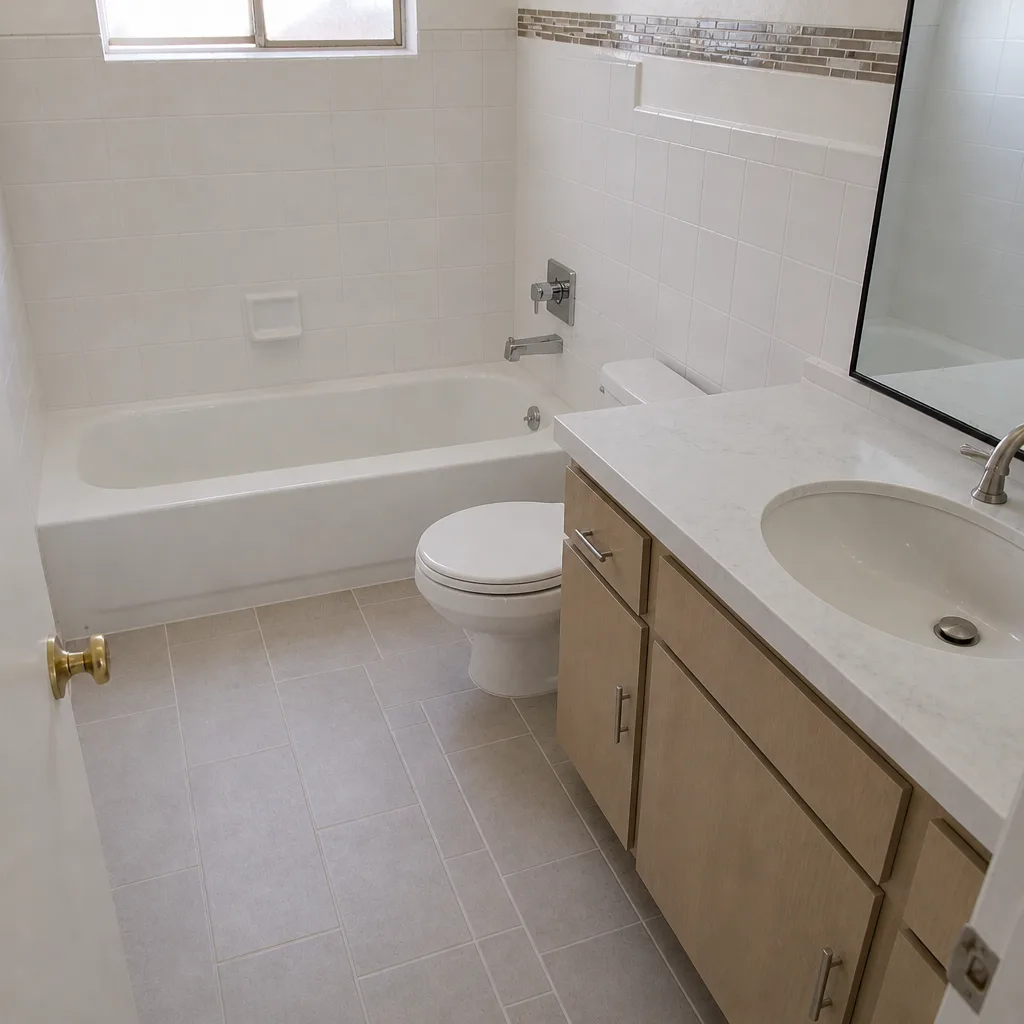 After
When to Call a Professional
Some maintenance is homeowner work. Some isn’t. Call a professional when you see any of these: water staining on the ceiling below the bathroom; a soft spongy feel in the floor tile (that’s a substrate moisture problem); grout that crumbles across more than a couple of lines; a shower that pools water against the wall; a leak that appears at a supply valve you can’t shut off cleanly; or any issue that’s reappeared twice after a home repair. These signal something structural or moisture-driven, and a second attempt at a DIY fix usually pays for itself in damaged rock and tile. Penhallow Remodeling Boulder City offers free estimates in Boulder City – call (844) 834-9740. We give you a written price before any work starts, and a written guarantee on every repair.
Frequently Asked Questions
Every 6 months for cement-based grout and every 4 to 6 months for natural stone, because Boulder City’s hard water carries enough dissolved minerals to penetrate grout that’s even a few months past its sealing window. Check by sprinkling a little water on the grout line: if it beads, it’s sealed; if it darkens and absorbs, it’s time. If you’re unsure, call (844) 834-9740 for a free estimate on grout regrouting and resealing.
Expect about $60 to $150 per year in consumables (caulk, sealer, a fan filter, a flapper) if you do the work yourself, and $300 to $600 per year if a contractor handles the annual reseal and recaulk. Compare that to a substrate repair or a tile tearout, which starts around $3,000. Thematic repair is the single best return on spend on any bathroom. Call (844) 834-9740 for a written annual maintenance quote.
Vinegar is safe on porcelain and ceramic tile but etches natural stone and damages grout sealer; bleach degrades sealer and can pit metal finishes. For any natural stone (travertine, marble, limestone), stick to a pH-neutral stone cleaner. For anything else, mild dish soap and water works for 90% of what you’ll face. Call (844) 834-9740 if you’re uncertain what your remodel used.
A written workmanship guarantee covers the installation itself: the tile, the caulk, the fixture install, the plumbing connections the contractor made. It typically doesn’t cover damage from wrong cleaners, missed maintenance, or a fixture manufacturer’s own defect (those carry their own warranty). Penhallow Remodeling includes a 365-Day Done Right Promise and a free return visit if a repair fails, both in writing. Call (844) 834-9740 for a free estimate and to review what’s covered.
Turn it on and hold a square of toilet paper against the grille. If the tissue holds, the fan is drawing air; if it falls, the fan isn’t pulling. Then remove the grille, clean the blades, and check that they spin freely. Do this every 6 months. If the fan is noisy, wobbly, or more than 12 years old, replace it. Call (844) 834-9740 for a free estimate on a fan upgrade.
Every closeout document: product brands and model numbers, grout and sealer brands, dated photos of every wall and fixture, the written price, the written guarantee, and any permit paperwork. This file is what makes a year-two warranty claim straightforward instead of a dispute. Ask your contractor for the full packet before final payment. Call (844) 834-9740 if you need a copy of your project file.
The Bottom Line
The bathroom schedule that protects your investment is short: reseal grout every 6 months in Boulder City’s hard water, recaulk wet joints annually, clean and test the exhaust fan twice a year, use pH-neutral cleaners on stone and mild soap on fixtures, and keep a dated photo file of every finish. That schedule costs a few hours a year and prevents most of the failures homeowners blame on their contractor. If something does fail, a written guarantee, a written price, and a dated file turn the conversation into a straightforward service call. The system works when the small tasks get done on time.
Our technicians have up to 22 years of experience, are background-checked, and arrive in uniform. A live person answers the phone around the clock.
Call (844) 834-9740 for a free estimate in Boulder City.
Written by the team at Penhallow Remodeling Boulder City.